
Lymphedema Liposuction and Debulking Surgery in Singapore
Considering specialist lymphatic assessment with Dr Jeremy Sun? LymphedAsia is an educational resource. For Dr Sun’s clinician profile and patient-facing Singapore consultation information, see Dr Jeremy Sun’s lymphedema surgery page and lymphovenous bypass / LVA surgery information. Online information does not replace individual medical consultation.
Clinically reviewed by Dr Jeremy Sun Mingfa. Dr Sun is a Senior Consultant Plastic and Reconstructive Surgeon in Singapore with dedicated fellowship-level training in lymphatic surgery, lymphovenous bypass (LVA), ICG lymphography and supermicrosurgical lymphatic reconstruction. This page is intended for general education and does not replace personalised medical assessment.
Lymphedema liposuction and debulking surgery are surgical options for selected patients with advanced, volume-dominant lymphedema. They are different from cosmetic liposuction. The goal is to reduce heavy fibrofatty tissue or severely diseased skin and soft tissue when swelling has become less fluid-dominant and less responsive to compression alone.
These procedures do not “cure” lymphedema or replace careful conservative care. Many patients still need long-term compression, skin care and follow-up after volume-reduction surgery. The right timing depends on examination findings, response to CDT/compression, cellulitis history and imaging such as ICG lymphography and ultrasound mapping.
Clinically reviewed by Dr Jeremy Sun Mingfa. Dr Sun is a Senior Consultant Plastic and Reconstructive Surgeon in Singapore with dedicated fellowship-level training in lymphatic surgery, lymphovenous bypass (LVA), ICG lymphography and supermicrosurgical lymphatic reconstruction. This page is intended for general education and does not replace personalised medical assessment.
When liposuction or debulking may be considered
In early or fluid-predominant lymphedema, treatment usually begins with skin care, exercise, compression garments, manual lymphatic drainage where appropriate and other components of conservative lymphedema care. Microsurgical options such as LVA / lymphovenous bypass may be considered in selected patients when usable lymphatic channels can be identified.
Liposuction or debulking tends to be discussed when the limb or affected area has a large solid component, fibrosis, thickened skin, recurrent infections, major functional limitation or persistent heaviness despite appropriate non-surgical treatment. It is best viewed as part of a staged treatment plan, not as a quick cosmetic procedure.
Lymphedema liposuction
Lymphedema liposuction removes excess fibrofatty tissue through small incisions using a cannula. It may be considered when swelling has become volume-dominant and less pitting, especially after long-standing disease. The expected benefit is usually limb-volume reduction and easier fitting of compression, rather than restoration of normal lymphatic anatomy.
Suitability depends on whether the problem is mainly fluid, fat/fibrosis, venous disease, skin change, obesity-related swelling or another diagnosis. In some patients, lymphatic reconstruction may be considered before, after or instead of liposuction, depending on the pattern of disease.
Does liposuction restore lymphatic flow?
Liposuction for advanced lymphedema has traditionally been regarded as a debulking or volume-reduction procedure. It can reduce heaviness, improve garment fitting and make the limb easier to manage, but most lymphatic surgeons do not consider liposuction by itself to repair blocked or damaged lymphatic vessels.
There is an important nuance. A 2025 paper from Wei F. Chen’s group, Debulking Lymphatic Liposuction: Are the Therapeutic Effects Limited to the Treated Limb?, reported improved lymphatic drainage patterns on ICG lymphography after lymphatic liposuction. This is an interesting observation, but it should be interpreted carefully.
One possible explanation is related to how ICG lymphography works. Near-infrared fluorescence has limited tissue penetration, often only around 1–2 cm beneath the skin. In a limb with very thick subcutaneous fibrofatty tissue, existing lymphatic signals may be too deep or obscured to visualise clearly. After liposuction thins this layer, the ICG signal may become easier to see. In that situation, the scan may look “better” partly because visibility has improved, not necessarily because new lymphatic function has been biologically restored.
This distinction matters. Properly planned lymphedema liposuction may be very helpful in selected patients with advanced fibrofatty disease. But liposuction performed without lymphatic expertise may potentially damage remaining superficial lymphatic channels. Lymphedema liposuction should therefore be planned differently from cosmetic liposuction, with attention to lymphatic imaging, disease stage, compression, infection history and whether LVA or VLNT has a role.
Dr Sun’s view: ICG improvement after liposuction is intriguing, but improved visibility is not the same as proven restoration of lymphatic function. This is why patients considering debulking surgery should see a lymphatic surgeon who understands both the surgical options and the limitations of lymphatic imaging.
Debulking and Charles-type procedures
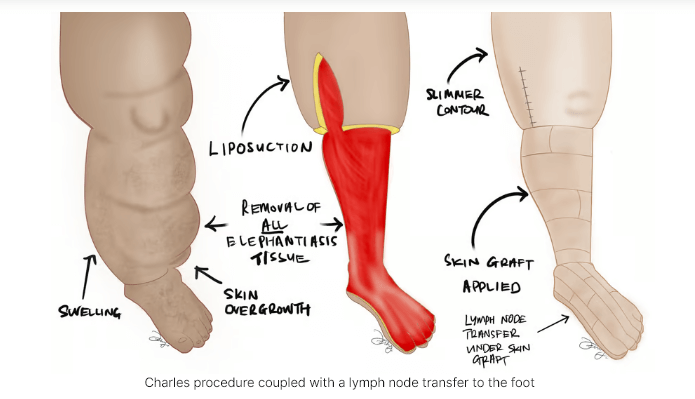
Debulking surgery removes diseased skin and soft tissue more extensively than liposuction. Charles-type procedures are generally reserved for very advanced lymphedema with severe skin thickening, recurrent infection, leakage, hygiene difficulty or functional impairment. These operations can involve longer wound healing, grafting and more intensive postoperative care.
Because debulking is a major intervention, patients should understand the trade-offs: scars, wound-care needs, compression requirements, infection risk and the possibility of further staged treatment. It should be discussed with a clinician experienced in lymphatic disease and reconstructive decision-making.
How this differs from LVA and VLNT
LVA/LVB, VLNT and liposuction answer different problems. LVA aims to bypass blocked lymphatic flow when usable lymphatic channels and suitable veins are present. VLNT introduces lymph-node-containing tissue in selected situations. Liposuction and debulking reduce excess solid volume when tissue change has become dominant.
For a fuller decision framework, see the LymphedAsia guide to LVA vs VLNT vs liposuction for lymphedema surgery and the LVA candidate checklist.
Compression, cost and questions before surgery
Compression after volume-reduction surgery
Compression is usually still important after lymphedema liposuction or debulking. It helps maintain volume reduction and supports the tissues while swelling is being controlled. The garment plan may need refitting as limb size changes. Stopping compression too quickly can allow swelling to recur in some patients.
If compression seems to be failing, the answer may not be immediate surgery. Garment fit, containment level, cellulitis, venous disease, weight change, fibrosis and the original diagnosis should all be reassessed.
Questions to ask before surgery
- Is my swelling mainly fluid-dominant, fibrofatty, fibrotic or mixed?
- Have I had adequate conservative treatment and properly fitted compression?
- Would ICG lymphography and ultrasound mapping change the decision?
- Is LVA, VLNT, liposuction, debulking or staged treatment most appropriate?
- What compression, wound care and follow-up will be needed after surgery?
- What factors affect the likely cost, hospital stay and recovery plan?
For cost variables without invented price ranges, read what affects lymphedema surgery cost in Singapore. For recurrent infection concerns, see lymphedema and cellulitis risk.
This article is educational and cannot determine individual suitability. Seek urgent medical care for rapidly spreading redness, fever, severe pain, confusion or concern for cellulitis/sepsis.