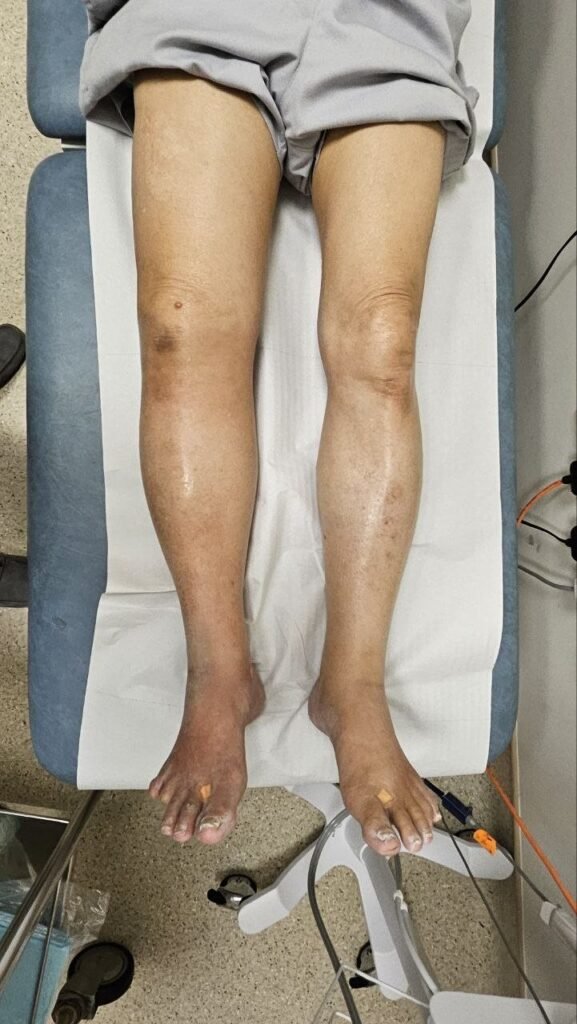
Your surgery is over. The wound is healing. But your arm or leg is still swollen, and it has been weeks. You keep asking yourself the same question: is this just normal healing, or is something else going on?
Clinically reviewed by Dr Jeremy Sun Mingfa, Senior Consultant Plastic and Reconstructive Surgeon in Singapore, with subspecialty expertise in lymphedema surgery and supermicrosurgical lymphatic reconstruction. Last reviewed: August 2026.
Most post-surgery swelling settles down on its own within a few weeks. But for a small number of patients, the swelling is the first sign of lymphedema, a chronic condition that needs early treatment to manage well. By the end of this article, you will know exactly which signs point to normal healing, which point to lymphedema vs post-surgery swelling, and what to do next.
What Is Normal Swelling After Surgery, and How Long Does It Last?
Some swelling after surgery is expected. When tissue is cut, your body sends extra fluid to the area to support healing. This is part of the normal inflammatory response, not a sign that anything has gone wrong.
In clinical practice, this means most patients see swelling peak in the first 3 to 5 days, then gradually improve. Typical post-operative swelling follows a predictable pattern: it is usually soft, it affects the area right around the incision, and it responds well to rest, ice, and keeping the limb raised.
Most surgical swelling fully resolves within 2 to 6 weeks, depending on the type and extent of the surgery. Larger operations, or those involving lymph node removal, can take longer to settle. If your swelling is following this kind of timeline and slowly getting better week by week, that is a reassuring sign.
How Do You Know If Your Swelling Is Lymphedema?
Lymphedema happens when your lymphatic system cannot drain fluid properly, usually because lymph nodes or vessels were removed or damaged during surgery (most often in cancer treatment, such as breast, gynecologic, or melanoma surgery). Instead of fluid draining away, protein-rich fluid builds up under the skin.
A few warning signs separate lymphedema from ordinary post-surgical swelling. Watch for swelling that keeps getting worse instead of better, swelling that does not go down overnight or after elevating the limb, a feeling of heaviness, tightness, or fullness in the limb, clothing, rings, or watches that suddenly feel tighter, and skin that feels firm or thick rather than soft.
One especially useful early sign is called the Stemmer sign: try gently pinching the skin at the base of a finger or toe on the swollen side. If you cannot pick up a fold of skin easily, or it feels noticeably thicker than the same spot on the other side, this can point toward lymphedema rather than ordinary swelling.
| DR. SUN’S CLINICAL PERSPECTIVE“the patients who do best are the ones who flag changes early, often before they are even sure something is wrong.”This means for patients that you do not need to wait for a textbook symptom list before getting checked. A same-day phone call describing what you are feeling is enough to start the process. |
Lymphedema vs Post-Surgery Swelling: A Side-by-Side Comparison
Sometimes the clearest way to compare two things is to see them side by side. Use the table below as a quick reference, but remember that it is a guide, not a diagnosis.
| Normal Post-Surgery Swelling | Lymphedema | |
|---|---|---|
| Timing | Starts within days of surgery | Can start weeks, months, or even years later |
| Pattern | Spreads evenly, often on both sides if both areas were operated on | Usually one-sided, often starting at the hand, foot, or limb furthest from the body |
| Skin feel | Soft, leaves a dent when pressed (pitting), bounces back over time | Can start soft, but skin may feel tight, heavy, or thick as it progresses |
| Response to rest/elevation | Improves with rest and elevation within 1-2 weeks | Improves only partly, or not at all, with rest and elevation |
| Duration | Resolves on its own, usually within 2-6 weeks | Does not resolve without treatment, and tends to get worse over time |
What Are the Early Post-Operative Lymphedema Signs Doctors Look For?
Doctors who specialize in lymphedema look beyond the swelling itself. They look at how the swelling behaves over time and what it feels like under the skin.
Three signs in particular tend to raise a flag in clinical assessments. The first is asymmetry, meaning one limb is now visibly larger than the other when before surgery they matched. The second is a change in skin texture, where the skin starts to feel tight, leathery, or like it has lost some of its natural elasticity. The third is a sensation of aching, tingling, or heaviness that is out of proportion to how the limb looks on the outside.
According to the International Society of Lymphology (ISL), lymphedema is typically staged from 0 to 3, starting with a latent stage where the lymphatic system is impaired but no visible swelling has appeared yet, through to advanced stages with significant skin changes. In clinical practice, this means swelling you can see is often not the earliest sign. Subtle changes, like a limb that simply feels different, can come first.
Can Post-Surgery Swelling Turn Into a Lymphedema Surgery Complication Later?
Yes, and this is one of the most important things to understand. Lymphedema does not always appear right away. It can develop weeks, months, or even years after surgery, particularly if lymph nodes were removed as part of cancer treatment.
This delayed onset is exactly why some patients are caught off guard. They assume that because their original surgical swelling went away months ago, any new swelling must be unrelated. In reality, your risk of lymphedema as a surgery complication does not disappear once you have recovered from the operation itself. It can remain elevated for the rest of your life, which is why ongoing awareness matters more than a single check at your post-op appointment.
The good news is that earlier detection leads to better long-term control. Lymphedema caught at an early stage is generally easier to manage with conservative methods like compression and manual lymphatic drainage, before more significant tissue changes set in.
What Should You Do If You Are Not Sure Which One You Have?
If you are still unsure whether your swelling is normal healing or something that needs specialist input, there are a few practical steps you can take right now.
- Track it visually. Take a photo of the swollen area today, and another in one week, so you have an objective record of whether it is improving or worsening.
- Test elevation response. Note whether the swelling fully disappears overnight or after you elevate the limb for 20 to 30 minutes.
- Compare both sides. Measure the circumference of both limbs at the same point and compare them, rather than relying on how things look or feel.
- Watch the 6-week mark. If swelling has lasted more than 6 weeks, is getting worse, or came back after initially improving, treat this as a signal to get assessed rather than waiting it out.
None of these steps replace a proper clinical assessment, but they give you useful information to bring to that appointment.
Lymphedema vs Post-Surgery Swelling: When to Get Expert Input
If you have concerns about lymphedema vs post-surgery swelling, speaking with a lymphedema specialist early can change your outcome. Dr Jeremy Sun consults at Lymphedema Asia in Singapore, offering assessment and treatment planning for patients dealing with post-surgical swelling and lymphedema, including those traveling from overseas for specialist care.