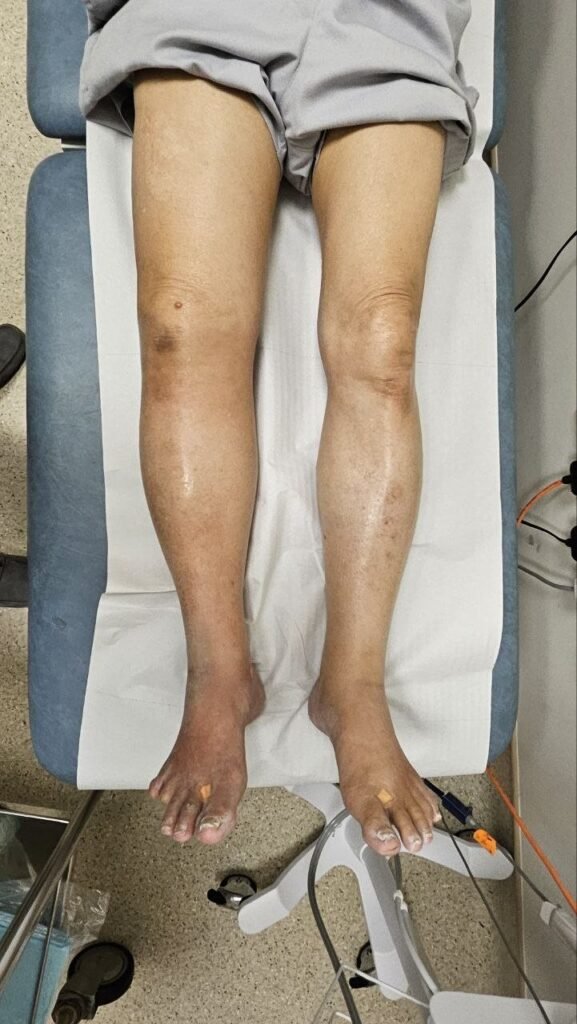
You have been told your legs are the way they are because of your weight. You have been told to eat less and move more. You have tried. The legs have not changed. The heaviness, the tenderness, the disproportionate swelling that stops at your ankles: none of it responds the way fat should respond.
Clinically reviewed by Dr Jeremy Sun Mingfa, Senior Consultant Plastic and Reconstructive Surgeon in Singapore, with subspecialty expertise in lymphedema surgery and supermicrosurgical lymphatic reconstruction. Last reviewed: August 2026.
What you may be experiencing is lipedema, a condition affecting fatty tissue distribution that is frequently misdiagnosed as obesity, general oedema, or lymphedema. Or you may have lymphedema. Or, increasingly recognised by specialists, you may have both at once.
The lymphedema vs lipedema misdiagnosis problem is not rare. It affects thousands of women who spend years in the wrong treatment pathway. This article explains how to tell the two conditions apart, why the distinction changes everything about your management, and when the presence of one condition may have triggered the other.
What Is Lipedema and Why Is It So Consistently Misdiagnosed?
Lipedema is a chronic disorder of fatty tissue [adipose tissue] that causes abnormal fat to accumulate symmetrically in the legs, hips, and sometimes the arms. It almost exclusively affects women. It is not caused by diet or lifestyle. It does not respond to caloric restriction or conventional weight loss strategies.
The condition typically appears or worsens around times of hormonal change: puberty, pregnancy, menopause, or after starting or stopping hormonal contraception. This hormonal pattern, combined with its near-exclusive occurrence in women, points toward a hormonal and genetic mechanism, though the exact cause remains an active area of research.
Lipedema is misdiagnosed so often for several reasons:
- It produces swelling and enlargement of the legs that visually resemble obesity or simple fluid retention
- Many healthcare providers have limited awareness of the condition and do not include it in their differential diagnosis for bilateral leg swelling
- Patients are frequently told to lose weight first before further investigation, which delays diagnosis by months or years.
- The condition does not show up on standard blood tests, and basic ultrasound findings may appear normal.
The defining feature that separates lipedema from obesity is the distribution of the tissue change. In lipedema, the abnormal fat accumulates symmetrically from the waist or hips downward, stopping sharply at the ankle. The feet are spared. This creates a distinctive ‘column leg’ appearance with a cuff-like transition at the ankle.
In clinical practice, this means that a woman with disproportionately large legs that stop swelling exactly at the ankle, who has not responded to diet or exercise, and who has female relatives with similar features, should be assessed for lipedema before any other diagnosis is accepted.
How Is Lipedema Different from Lymphedema in Its Symptoms and Presentation?
The two conditions share some surface features: both cause leg enlargement, both can cause a feeling of heaviness, and both are more common in women. But the clinical picture differs in ways a specialist can clearly identify.
Pain and Tenderness
Lipedema tissue is characteristically painful and tender to the touch. Even light pressure on the affected areas causes discomfort. Many women with lipedema bruise easily and report that their legs hurt after standing or walking, not just at the end of a long day but consistently.
Lymphedema, by contrast, is not typically painful in early stages. The swelling may feel heavy or tight, but the tissue itself is not tender, as lipedema tissue is. When lymphedema does become painful, it often signals infection [cellulitis] or significant fibrotic change.
Foot and Toe Involvement
This is one of the most reliable distinguishing features between the two conditions. Lipedema stops at the ankle. The feet and toes are not involved. The transition between the affected leg and the normal foot is often abrupt and visible.
Lymphedema involves the feet. Swelling extends across the dorsum [top] of the foot and into the toes. Stemmer’s sign, the inability to lift a skin fold at the base of the second toe, is positive in lymphedema and negative in lipedema. This single physical finding provides significant diagnostic information.
Response to Elevation and Compression
Lymphedema at Stage 1 reduces somewhat with elevation overnight. General fluid from lymphedema can be shifted temporarily. Lipedema tissue does not meaningfully change with elevation because the primary problem is abnormal fat accumulation, not fluid overload.
Compression garments reduce the fluid component of lymphedema but have a limited effect on lipedema fat tissue. Patients who find that compression helps them significantly are more likely to have lymphedema or a combined condition. Patients who find compression uncomfortable but minimally helpful for the swelling itself may have pure lipedema.
Bilateral Symmetry
Lipedema is almost always bilateral and symmetric. Both legs are affected to roughly the same degree. Pure lymphedema, particularly secondary lymphedema after cancer surgery, is frequently asymmetric: one limb is considerably more affected than the other.
Bilateral symmetric leg swelling in a woman with no history of cancer treatment or infection, combined with tenderness and foot sparing, is a pattern that points toward lipedema rather than lymphedema.
| DR. SUN’S CLINICAL PERSPECTIVE“In my practice, I see women who have been told for years that their leg heaviness and disproportionate lower-body swelling are a weight problem or poor circulation. By the time they reach me, several have developed lipo-lymphedema: the lipedema has placed enough chronic stress on their lymphatic system that secondary lymphedema has now developed on top. The tragedy is that the lymphedema component is often still in an early, treatable stage. Had it been identified sooner, we would have had more options. Correct diagnosis is not just about naming the condition correctly. It is about preserving the treatment options that time will otherwise close.”Dr. Jeremy Sun, Lymphedema Microsurgery Specialist, Singapore |
How Do Lipedema and Lymphedema Compare Across the Key Clinical Features?
The table below summarises the distinguishing features your specialist will use to differentiate these two conditions at assessment:
| Feature | Lipedema | Lymphedema |
| Who is affected | Almost exclusively women; affects all body types | Both men and women are often linked to cancer treatment or infection |
| Distribution | Bilateral, symmetric, from the waist or hips to the ankle. Feet are typically spared. | Can be unilateral or bilateral. Feet and toes are commonly involved. |
| Pain on touch | Yes. Tissue is tender and bruises easily, even with light pressure. | Not typically painful to touch unless lipo-lymphedema has developed. |
| Stemmer’s sign | Negative. Feet are spared; skin at the digit base remains normal. | Positive from Stage 1 onwards. Key distinguishing feature. |
| Foot involvement | Feet spared: swelling stops at the ankle, creating a distinct cuff | Feet and toes involved: dorsal foot swelling and toe changes present |
| Effect of dieting | Fat in affected areas does not reduce with caloric restriction | Swelling is fluid-based; dietary changes do not reduce lymphedema |
| Response to CDT | Partial improvement in the fluid component, but fat tissue does not reduce | Complete decongestive therapy reduces swelling meaningfully |
| Tissue type | Abnormal fat cells are accumulating in the subcutaneous tissue | Protein-rich lymph fluid with progressive fibrosis over time |
| Familial pattern | Strongly familial; often multiple female relatives affected | Primary form can be hereditary; secondary form is not inherited |
| Primary treatment | Conservative management, manual drainage, and liposuction in select cases | CDT, compression garments, and microsurgery for eligible patients |
The three most decisive rows for self-assessment purposes are foot involvement, Stemmer’s sign, and pain on touch. Lipedema spares the feet and produces no positive Stemmer’s sign, but is reliably painful to touch. Lymphedema involves the feet, produces a positive Stemmer’s sign, and is not typically painful unless complicated.
What Is Lipo-Lymphedema and How Does One Condition Trigger the Other?
Lipo-lymphedema is a combined condition in which lipedema has placed sufficient chronic stress on the lymphatic system that secondary lymphedema has developed alongside it. This is not a rare complication. It is, according to specialist clinical experience, a common progression in patients whose lipedema was not diagnosed or managed for many years.
The mechanism is straightforward. Lipedema tissue is abnormal fat that compresses and impairs the lymphatic vessels running through it. Over months and years, this compression reduces lymphatic transport capacity. Eventually, the lymphatic system can no longer compensate for the fluid load, and secondary lymphedema develops on top of the existing lipedema.
The result is a condition that is more complex to manage than either diagnosis alone. The lymphatic component needs lymphedema-specific treatment. The lipedema component needs its own management pathway. Getting the balance right requires a specialist assessment of both.
Clinical signs that lipedema may be progressing toward lipo-lymphedema include:
- Swelling that previously stopped at the ankle is now extending to the feet and toes
- A previously negative Stemmer’s sign is becoming positive
- The swelling that previously reduced overnight now persists through the morning
- Skin changes in the foot and ankle area that were not previously present
In clinical practice, this means that a lipedema diagnosis is not static. Patients with lipedema need periodic reassessment of their lymphatic function, particularly if their symptoms are changing. A specialist who manages only the lipedema component while missing emerging lymphedema will provide incomplete care.
What Are the Treatment Differences Between Lipedema and Lymphedema?
Getting the diagnosis right matters so much precisely because the treatments diverge significantly. Applying lymphedema treatment to pure lipedema, or vice versa, produces poor results and can delay appropriate management by years.
Treatment for Lipedema
Conservative management for lipedema focuses on reducing the fluid component of swelling and managing pain, while accepting that the abnormal fat tissue itself will not reduce with standard approaches. This includes:
- Manual lymphatic drainage (MLD): specialised massage that reduces the fluid component within lipedema tissue and can decrease pain and heaviness
- Flat-knit compression garments: different from standard compression stockings and designed for the specific tissue profile of lipedema
- Low-impact exercise: aquatic therapy and walking are particularly well-tolerated
- Anti-inflammatory nutritional strategies: Some evidence supports dietary approaches that reduce systemic inflammation, though these do not reduce the fat tissue itself
Liposuction, performed by a surgeon with lipedema-specific expertise using water-assisted or tumescent techniques, is the only treatment that removes the abnormal fat tissue itself. This is not cosmetic liposuction. It is a medical procedure requiring careful patient selection and technique to preserve the lymphatic vessels running through the tissue.
Liposuction for lipedema does not cure the condition, but it can significantly reduce the tissue volume, reduce pain, and improve mobility. In some patients, it also reduces the lymphatic stress that was driving progression toward lipo-lymphedema.
Treatment for Lymphedema
The international gold standard for lymphedema management is complete decongestive therapy (CDT), which combines manual lymphatic drainage, compression garments, specific exercise, and skin care in a structured programme.
For eligible patients with early-stage lymphedema, microsurgical options may be available. Lymphovenous anastomosis (LVA) connects lymphatic vessels directly to nearby veins, creating a bypass around the damaged area. Vascularised lymph node transfer (VLNT) transplants healthy lymph nodes to restore drainage function. Both procedures require specialist expertise and are most effective at ISL Stages 1 and early Stage 2.
For patients with lipo-lymphedema, both treatment pathways may need to run concurrently under a coordinated care plan. The lymphedema component is typically addressed first to stabilise the lymphatic system before any intervention on the lipedema fat tissue.
Is It Time to Get a Definitive Diagnosis for Your Leg Swelling?
Years of being told your legs are a weight problem, or years of lymphedema treatment that is not quite working, are not inevitable. The lymphedema vs lipedema misdiagnosis problem is solvable with the right specialist assessment. Both conditions are diagnosable, both are manageable, and the combined condition of lipo-lymphedema is identifiable and treatable at any stage.
Dr Jeremy Sun is a lymphedema microsurgery specialist based in Singapore. His clinic, LymphEDasia, provides specialist assessment of both lymphedema and the lymphatic complications of lipedema, including clinical staging, Stemmer’s sign evaluation, ICG lymphography, and treatment planning for patients across Asia and internationally.
| Is It Time to See a Specialist?Seek specialist assessment with Dr Jeremy Sun at LymphEDasia if any of the following apply:→ You have bilateral leg swelling that is tender to touch, has not responded to dieting or diuretics, and has been present since puberty or a hormonal change such as pregnancy or menopause→ You have been diagnosed with lipedema and are now noticing swelling that extends to your feet, or swelling that no longer reduces overnight, suggesting a lymphatic component may have developed→ You have had cancer treatment and have both diffuse leg heaviness and localised swelling, and are unsure whether you are dealing with one condition or twoBook a consultation at LymphEDasia, Singapore → |
| KEY TAKEAWAYS |
| ✓ Lipedema is a disorder of abnormal fat distribution, almost exclusively affecting women, that is not caused by diet and does not respond to weight loss. It is frequently misdiagnosed as obesity or lymphedema. |
| ✓ The most reliable distinguishing features: lipedema spares the feet and is painful to touch; lymphedema involves the feet, produces a positive Stemmer’s sign, and is not typically tender. |
| ✓ Lipo-lymphedema is a combined condition where chronic lipedema has damaged the lymphatic system and secondary lymphedema has developed. It requires management of both components. |
| ✓ Treatment for lipedema and lymphedema diverges significantly: applying the wrong treatment produces poor results and delays appropriate care. |
| ✓ Any woman with bilateral leg swelling that is tender, foot-sparing, and unresponsive to diet or diuretics should be evaluated for lipedema and assessed for a lymphatic component before the diagnosis is finalised. |