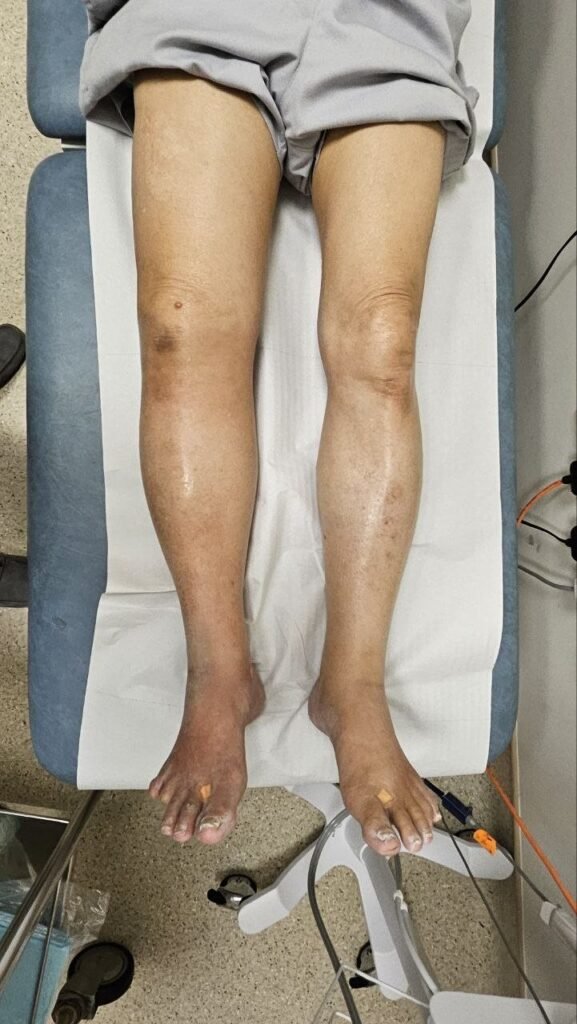
You finished cancer treatment. You were told to watch for swelling. But nobody told you exactly what to watch for, or how subtle the first signs can be.
Clinically reviewed by Dr Jeremy Sun Mingfa, Senior Consultant Plastic and Reconstructive Surgeon in Singapore, with subspecialty expertise in lymphedema surgery and supermicrosurgical lymphatic reconstruction. Last reviewed: August 2026.
Most people picture lymphedema as a dramatically swollen limb. The reality is different. The earliest signs are quiet. A feeling of heaviness. A sleeve that fits differently. Skin that feels slightly different to the touch. These signs appear months or even years before any visible swelling, and this early window is precisely when treatment works best.
This article lists all 12 early signs of lymphedema that cancer survivors should know, explains why each matters, and tells you exactly when those signs require specialist assessment rather than watchful waiting.
Why Do Early Signs of Lymphedema Appear Before Any Visible Swelling?
Your lymphatic system has a reserve capacity. After surgery removes lymph nodes, or radiation damages lymphatic vessels, the remaining system compensates. It works harder to move the same volume of fluid through fewer pathways.
This compensated phase is called Stage 0, or subclinical lymphedema. The system is already impaired, but impairment has not yet overflowed into visible swelling. Symptoms at this stage are sensory and functional, not visual.
Stage 0 can last months or years. Some patients never progress beyond it, particularly those who receive early intervention. Others tip into Stage 1 when the compensated system faces additional stress: a long flight, an infection, prolonged heat, or an increase in physical activity.
The ISL staging system recognises Stage 0 as a clinically distinct and important phase precisely because it represents the best opportunity for treatment. Catching lymphedema here, before fibrosis [scarring of the tissue] begins, preserves the most treatment options, including microsurgical reconstruction.
In clinical practice, this means that a cancer survivor reporting unusual heaviness or tightness in the at-risk limb, with no visible swelling, still warrants specialist assessment. The absence of visible swelling does not mean the absence of lymphatic impairment.
What Are the First 6 Early Signs of Lymphedema to Watch For?
These signs appear most commonly in the early subclinical and Stage 1 phases. They are easy to dismiss individually. Together, especially in a cancer survivor, they carry significant clinical weight.
| 1 | Persistent heaviness or aching in the limbNot pain exactly, but a tiredness or weighted feeling in the arm or leg on the treated side. It may be worse at the end of the day. It may ease overnight. Many patients describe it as the limb feeling like it is working harder than it should. |
| 2 | Tightness or fullness that was not there beforeA sensation of pressure under the skin, particularly in the forearm, hand, lower leg, or foot on the at-risk side. This is distinct from normal post-surgical swelling, which typically resolves within weeks of the procedure. |
| 3 | Clothing or jewellery fitting differently on one sideA watch, bracelet, ring, or sleeve that is slightly tighter on the treated side than before. Many patients notice this before they notice any visible difference in limb size. This is a measurable, objective change worth reporting. |
| 4 | Reduced flexibility or range of movementStiffness in the wrist, hand, ankle, or foot on the at-risk side. The joint itself may be structurally fine, but early fluid accumulation around it creates a subtle restriction. You may notice this during specific movements rather than at rest. |
| 5 | Skin that feels warmer than usual on the at-risk sideLocalised warmth without redness can indicate early lymphatic inflammation. This is distinct from cellulitis [skin infection], which typically presents with redness, pain, and fever. Persistent warmth on one side only, without other signs of infection, is worth noting. |
| 6 | Intermittent puffiness that comes and goesEarly lymphedema may not be constant. The limb swells and reduces, often tracking with activity level, time of day, or heat. Many patients describe swelling that appears after a flight or a long day and then resolves, before eventually becoming more persistent. This fluctuating pattern is the Stage 0 to Stage 1 transition. |
| DR. SUN’S CLINICAL PERSPECTIVE“In my practice, I see cancer survivors who noticed something unusual in the months after treatment but waited to mention it because they did not want to be a difficult patient, or because they feared what it might mean. By the time they come to me, what was a Stage 0 or Stage 1 finding has progressed to Stage 2. The early signs of lymphedema are easy to dismiss. A feeling of heaviness. Clothes fit tighter on one side. Slight puffiness that comes and goes. These are not trivial complaints. They are the window when we can intervene most effectively. I want every cancer survivor to know: reporting these symptoms early is not overreacting. It is the right thing to do.”Dr Jeremy Sun, Lymphedema Microsurgery Specialist, Singapore |
What Are Signs 7 to 12 That Indicate Lymphedema May Be Progressing?
These signs appear as lymphedema moves from subclinical into Stage 1 and Stage 2. They indicate that the lymphatic system is no longer compensating adequately and that specialist assessment is urgent.
| 7 | Visible swelling that does not resolve overnightOnce swelling is present in the morning before the day has started, Stage 1 has likely been reached or surpassed. At Stage 1, elevation still reduces swelling significantly. At Stage 2, it does not. The transition between these two behaviours is a clinically significant change. |
| 8 | Skin that pits when pressedPress firmly into the swollen area for five seconds and release. If an indentation [pit] remains, this is pitting oedema. Early lymphedema is often pitting before the tissue has undergone fibrotic change. Noticing this on yourself is a reliable sign that visible swelling has begun, and specialist review is needed. |
| 9 | Skin texture changes on the affected limbThe skin may feel slightly thicker, drier, or less supple than the skin on the other limb. Early changes are subtle and easier to detect by comparison than in isolation. Run the back of your fingers across both limbs in the same location and note any difference in texture. |
| 10 | Recurrent skin infections on the at-risk limbProtein-rich lymph fluid that cannot drain creates an environment where bacteria thrive. Cellulitis [a bacterial skin infection] recurring in the same limb, particularly the at-risk limb after cancer treatment, is a red flag. Each infection episode can cause further lymphatic damage, accelerating progression. |
| 11 | A positive Stemmer’s sign at the digit baseAttempt to lift a fold of skin at the base of your second toe or second finger on the at-risk side. If the skin feels thick, hard, and cannot be easily lifted into a small fold, this is a positive Stemmer’s sign and is specific to lymphedema. Compare directly with the opposite side. |
| 12 | Asymmetry confirmed by measurementMeasure the circumference of both arms or both legs at the same anatomical points: for the arm, typically at the wrist, forearm, elbow, and upper arm. A consistent difference of 2cm or more at any point between the at-risk and the unaffected limb is clinically significant and meets the threshold for lymphedema diagnosis in many specialist protocols. |
How Soon After Cancer Treatment Can These Signs Appear?
Lymphedema can appear at any point after treatment, not just in the first few months. This is one of the most important facts for cancer survivors to understand, and one of the most frequently underestimated.
The peak risk period for breast cancer-related arm lymphedema is within the first two years after surgery. But cases presenting five, ten, or even fifteen years after treatment are well documented in clinical literature.
Factors that can trigger lymphedema onset or worsen subclinical lymphedema include:
- Air travel, particularly long-haul flights, where cabin pressure changes and prolonged immobility combine to stress the lymphatic system
- Infection or injury in the at-risk limb, which increases lymphatic demand suddenly
- Significant weight gain, which increases the fluid load the lymphatic system must manage
- Periods of prolonged heat, including hot climates, saunas, or hot baths
- Vigorous unaccustomed exercise involving the at-risk limb without compression
This list is not a reason to avoid these activities. It is a reason to know your risk, monitor your limb appropriately, and seek assessment if symptoms develop.
In clinical practice, this means that a cancer survivor who completed treatment three years ago and is now noticing the early signs of lymphedema for the first time is not experiencing a different condition. They are likely experiencing delayed onset of post-treatment lymphedema, and their window for early intervention is still open.
Is It Time to See a Specialist About Your Symptoms?
Lymphedema identified at Stage 0 or Stage 1 offers the broadest range of treatment options, including microsurgical reconstruction for appropriate candidates. Lymphedema identified at Stage 2 or Stage 3 requires intensive management of a condition that has already undergone permanent tissue change.
Reporting symptoms early is not overreacting. It is the clinical decision that preserves your options.
Dr Jeremy Sun is a lymphedema microsurgery specialist based in Singapore. His clinic, LymphEDasia, provides specialist lymphedema assessment for cancer survivors, including bioimpedance spectroscopy for subclinical detection, ICG lymphography for vessel mapping, and staged treatment planning from conservative management to microsurgical reconstruction.
| KEY TAKEAWAYS |
| ✓ The earliest signs of lymphedema are sensory, not visual: heaviness, tightness, fullness, and reduced range of movement appear before any visible swelling. |
| ✓ Stage 0 lymphedema is a clinically recognised phase with no visible swelling but measurable lymphatic impairment. It is the most important phase for intervention. |
| ✓ Lymphedema can appear years after cancer treatment, not just in the first months. The risk period extends for the lifetime of the at-risk limb. |
| ✓ A positive Stemmer’s sign and a consistent circumference difference of 2cm or more between limbs are objective, measurable indicators requiring specialist assessment. |
| ✓ Reporting early symptoms promptly to a specialist is the clinical decision that preserves the most treatment options, including microsurgical reconstruction. |
Related surgical assessment guide: For patients comparing options such as lymphatic imaging, ICG lymphography, LVA / LVB and lymphovenous bypass, see LVA surgery in Singapore: lymphovenous bypass for lymphedema.