
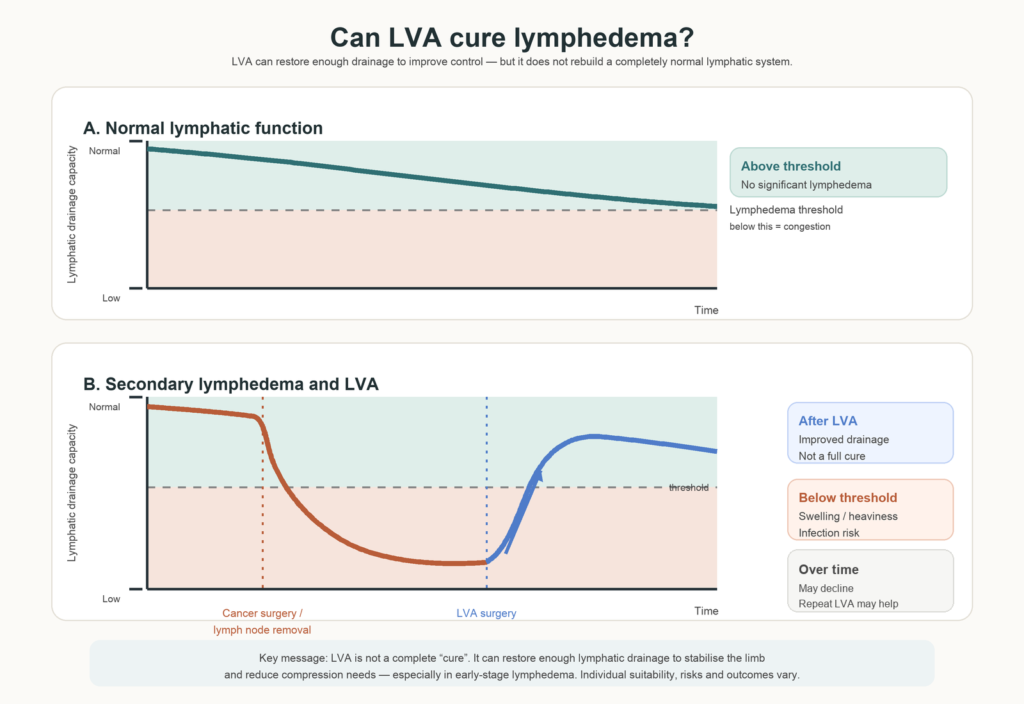
Short answer: LVA cannot truly cure lymphedema in the sense of restoring a completely normal lymphatic system. However, lymphaticovenous anastomosis (LVA) can improve lymphatic drainage enough for the limb to become more stable, less swollen, and easier to manage.
For many patients, the practical goal is not to make the lymphatic system “perfect” again. The goal is to restore enough drainage capacity so that the limb is no longer constantly congested.
Related specialist guides: Can I stop wearing compression after LVA? and Why early LVA gives better results.
Understanding lymphedema as a drainage-capacity problem
A helpful way to understand lymphedema is to imagine the lymphatic system as a drainage network with spare capacity. A limb does not necessarily need perfect lymphatic function to remain stable, but it does need enough working drainage to avoid persistent congestion.
Cancer surgery, lymph node removal, radiotherapy, infection, trauma, or progressive scarring can reduce that drainage capacity. When the remaining lymphatic function falls below what the limb needs, fluid accumulates and lymphedema becomes clinically apparent.
What LVA actually does
LVA does not reconstruct an entirely new lymphatic system. Instead, it creates tiny bypasses between functioning lymphatic channels and nearby veins, allowing lymph fluid to drain through an alternative route.
In suitable patients, this may improve drainage enough to bring the limb back above its congestion threshold. This can lead to better swelling control, less heaviness, fewer cellulitis episodes, and improved quality of life.
So is LVA a cure?
Medically, it is more accurate to say that LVA improves lymphatic function rather than cures lymphedema. The original lymphatic injury is still present, and the limb may not return completely to its pre-lymphedema state.
However, the improvement can still be very meaningful. Some patients are able to reduce how long they wear compression garments. Selected patients, especially those treated early, may be able to wean off compression for long periods under specialist guidance.
For some patients, not needing to wear compression every day can feel almost like being cured — even though the lymphatic system has not been fully restored to normal.
Why early-stage LVA tends to do better
LVA usually works best when there are still healthy lymphatic channels that can be identified and connected. In earlier-stage lymphedema, the vessels are more likely to remain functional, which can improve the chance of a useful response.
This is why early diagnosis, appropriate compression therapy, imaging such as ICG lymphography or ultrasound, and timely surgical assessment can matter. Earlier intervention may improve symptom control and patient satisfaction, although outcomes vary between individuals.
Why lymphedema can worsen again over time
Lymphatic function can continue to decline over time. Cellulitis, trauma, inflammation, scarring, additional surgery, or radiotherapy can further damage an already vulnerable drainage system.
For this reason, some patients may need repeat LVA or additional treatment in the future. This does not always mean the first operation “failed”; it may reflect ongoing changes in the lymphatic system.
The practical goal of LVA
The practical goal of LVA is to improve lymphatic drainage enough for the limb to become more stable and less dependent on external support. It is not a guaranteed cure, but for the right patient, it can be a major improvement in daily life.
Related reading
- Lymphedema surgery in Singapore: options, LVA and specialist assessment
- LVA surgery recovery in Singapore
- Can lymphedema be cured?
- Private lymphedema consultation in Singapore
This article is for general education and does not replace a personalised consultation. Suitability for LVA, risks, recovery, compression requirements, and outcomes vary between patients.
Related guide: When Is LVA Surgery Too Late for Lymphedema? explains how pitting, fibrosis and narrowed lymphatic channels affect whether LVA remains suitable in later-stage lymphedema.
Related surgical assessment guide: For patients comparing options such as lymphatic imaging, ICG lymphography, LVA / LVB and lymphovenous bypass, see LVA surgery in Singapore: lymphovenous bypass for lymphedema.