

Your leg has been swollen for weeks. Maybe months. You’ve been told to “elevate it” and “drink more water.” But the swelling isn’t going away, and you’re starting to wonder if something is seriously wrong.
Clinically reviewed by Dr Jeremy Sun Mingfa, Senior Consultant Plastic and Reconstructive Surgeon in Singapore, with subspecialty expertise in lymphedema surgery and supermicrosurgical lymphatic reconstruction. Last reviewed: August 2026.
The answer may lie in a system most doctors rarely talk about: your lymphatic system. When it works, you never notice it. When it fails, the consequences are visible, uncomfortable, and, if untreated, progressive.
By the end of this article, you will understand exactly how the lymphatic system function affects lymphedema, why lymphedema develops, and when it is time to stop waiting and get a proper diagnosis.
What Does Your Lymphatic System Actually Do?
Think of your cardiovascular system as your body’s main highway. Blood travels out from the heart, delivers oxygen and nutrients, and returns. But that highway has a leak problem: every day, about three litres of fluid seep out of your blood vessels into surrounding tissue.
Your lymphatic system is the drainage network that collects this leaked fluid, called lymph, and returns it to your bloodstream. Without it, your tissues would fill with fluid, proteins would accumulate, and your immune system would collapse.
Here is what the lymphatic system does every single day:
- Collects excess fluid from tissues through tiny vessels called lymphatic capillaries
- Filters that filter fluid through lymph nodes, trapping bacteria, waste, and abnormal cells
- Returns clean fluid into circulation via the thoracic duct near your collarbone
- Transports immune cells (lymphocytes) throughout your body to fight infection
In clinical practice, this means the lymphatic system is not just a drainage pipe; it is a critical part of your immune defence. When it is compromised, you are not just dealing with swelling. You are dealing with a system-wide failure.
How Does Lymph Fluid Actually Move Through Your Body?
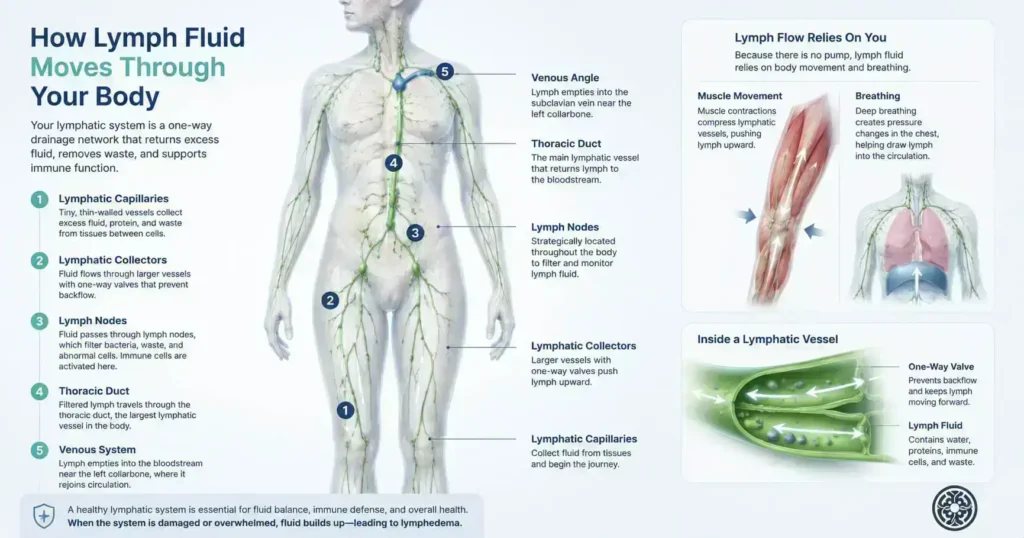
Unlike your heart, your lymphatic system has no pump. It relies on movement, muscle contractions, and breathing to push lymph fluid through a network of vessels that spans your entire body.
Lymphatic capillaries are the starting point. These ultra-thin vessels are present in almost every tissue in your body. Their walls are slightly permeable, which allows excess fluid and protein molecules to pass in from the surrounding tissue.
From there, fluid moves through progressively larger vessels called lymphatic collectors, then into regional lymph nodes. These nodes, you have between 500 and 700 of them, act as checkpoints. They filter the fluid, flag infections, and pass clean lymph forward.
The filtered lymph then flows into the largest lymphatic vessel in your body, the thoracic duct, and empties into the venous system near your left collarbone. Fluid from your right arm and the right side of the head drains through a smaller right lymphatic duct.
In clinical practice, this means that any disruption along this pathway, damaged capillaries, scarred nodes, or blocked collectors, can cause fluid to back up. That backup is what you see as swelling.
| DR. SUN’S CLINICAL PERSPECTIVE“In my practice, I see patients who have been told their swelling is ‘just fluid’ for months, sometimes years, before being properly assessed. The lymphatic system is invisible on standard imaging unless you know what to look for. This means that for patients, a correct diagnosis early is not a luxury; it is the difference between reversing damage and managing it for life.”– Dr Jeremy Sun, Lymphedema Microsurgery Specialist, Singapore |
What Goes Wrong When Lymphedema Develops?
Lymphedema occurs when the lymphatic transport capacity falls below the volume of fluid the system needs to move. This is not a sudden event; it is typically a slow, progressive failure that begins invisibly.
There are two primary types. Primary lymphedema results from a developmental abnormality in the lymphatic vessels themselves; the system was never fully formed. Secondary lymphedema, the more common form, occurs when a previously healthy system is damaged.
The most common causes of secondary lymphedema include:
- Cancer surgery or radiation that removes or damages lymph nodes (most frequently after breast cancer, melanoma, or gynaecological cancers)
- Infection, particularly filariasis (parasitic infection), is the leading cause of lymphedema worldwide
- Trauma, chronic venous insufficiency, or obesity, placing excessive load on the lymphatic system
When lymph fluid cannot drain, protein-rich fluid accumulates in the interstitial tissue. Over time, this triggers a chronic inflammatory response. Fatty tissue deposits. Skin thickens. The condition progresses through four clinical stages, defined by the International Society of Lymphology (ISL), from reversible early swelling to irreversible hardening of tissue.
Understanding this progression matters because the earlier the intervention, the more of the system can be preserved or restored.
How Is a Healthy Lymphatic System Different from One with Lymphedema?
The table below shows what changes, and why it matters, when lymphedema develops:
| Healthy Lymphatic System | When Lymphedema Develops | |
| Fluid transport | Lymph vessels carry fluid away efficiently | Damaged vessels cannot drain fluid properly |
| Node function | Nodes filter waste and pathogens normally | Nodes may be absent, scarred, or blocked |
| Limb appearance | Normal size and skin texture | Visible swelling, skin changes over time |
| Protein levels | Protein stays in circulation | Protein accumulates in the tissue, worsening swelling |
| Reversibility | A healthy system self-regulates | Requires active treatment; damage can be permanent |
The critical column is the last one. Every change in lymphedema represents damage that accumulates over time. Protein builds in tissue. Inflammation becomes chronic. Fat is deposited. This is why waiting and watching is rarely the right strategy.
How Do You Know If Your Swelling Is Lymphedema?
Swelling has many causes, including heart failure, kidney disease, venous insufficiency, and medication side effects are all possibilities. But lymphedema has several distinguishing features that should prompt specialist evaluation.
Pitting vs. non-pitting oedema is one of the first distinctions. In early lymphedema, pressing your finger into the swollen area may leave an indentation (pitting). As the condition progresses and protein accumulates in the tissue, the swelling becomes firmer, and the pit disappears.
Other features that suggest lymphedema over other causes of swelling:
- Swelling that is worse at the end of the day or after prolonged standing, but does not fully resolve overnight
- A feeling of heaviness, tightness, or reduced flexibility in the affected limb
- Skin changes, thickening, a rough texture, or, in later stages, a condition called hyperkeratosis
- Stemmer’s sign: inability to pinch and lift the skin at the base of the second toe (a reliable early clinical indicator)
- History of cancer treatment, infection, or trauma in the affected region
According to ISL consensus guidelines, a clinical diagnosis of lymphedema requires a thorough history, physical examination, and, in many cases, specialised imaging such as lymphoscintigraphy or indocyanine green (ICG) lymphography to assess vessel function directly.
Is It Time to See a Lymphedema Specialist?
Many patients wait too long. They adjust to the swelling. They wear looser clothes. They stop activities that make it worse. By the time they seek specialist care, months or years have passed,d and the window for the most effective interventions has narrowed.
You should seek a specialist assessment if any of the following apply:
- Your swelling has persisted for more than four weeks without a clear, treated cause
- You have had surgery, radiation, or infection in the affected region, even years ago
- Your swelling is asymmetric: one limb is noticeably larger than the other
Dr Jeremy Sun is a lymphedema microsurgery specialist based in Singapore with clinical expertise in lymphatic system function, lymphedema diagnosis, and surgical reconstruction. His practice, LymphEDasia, serves both local patients and international patients seeking specialist care in Asia.
Early diagnosis and treatment of lymphatic system dysfunction can meaningfully change the trajectory of this condition. The lymphatic system is silent when it works. Do not wait until it is not.
| Book your lymphedema consultation with Dr Jeremy Sun at Lymphedema Asia, Singapore → |
| KEY TAKEAWAYS |
| ✓ The lymphatic system drains 3+ litres of fluid from your tissues daily and is essential for immune function. |
| ✓ Lymphedema occurs when lymphatic transport capacity fails, typically after cancer treatment, infection, or trauma. |
| ✓ Protein-rich fluid accumulation drives progressive tissue damage through four ISL-defined stages. |
| ✓ Key signs include asymmetric swelling, heaviness, skin changes, and a positive Stemmer’s sign. |
| ✓ Early specialist assessment, before fibrosis sets in, significantly improves treatment outcomes. |