
Many patients with lymphedema ask whether they have “missed the window” for lymphaticovenous anastomosis, or LVA surgery.
The honest answer is: LVA tends to work best when it is done earlier, but late does not always mean too late. The key question is whether there are still functioning lymphatic channels that can be connected to nearby veins.
LVA is not a cure for lymphedema. It is a way of improving lymphatic drainage by creating small bypasses between blocked lymphatic vessels and the venous system. If suitable lymphatic channels are still present, LVA may reduce swelling, heaviness, infection risk and dependence on compression.
Why early LVA usually gives better results
In early lymphedema, swelling is often still soft and pitting. This usually means that there is still a significant fluid component and that some lymphatic channels are still functioning.
These patients often have better outcomes after LVA because the operation is restoring drainage before the limb has undergone major irreversible changes. They are also more likely to reduce their dependence on compression garments.
- Less heaviness and tightness
- Less swelling fluctuation through the day
- Fewer cellulitis or infection episodes
- Better comfort during work, travel and exercise
- A better chance of reducing compression use
Even when the limb does not return completely to normal size, being able to wear compression for fewer hours — or sometimes stop compression for longer periods — can feel almost like being cured to some patients.
What makes LVA less effective in late-stage lymphedema?
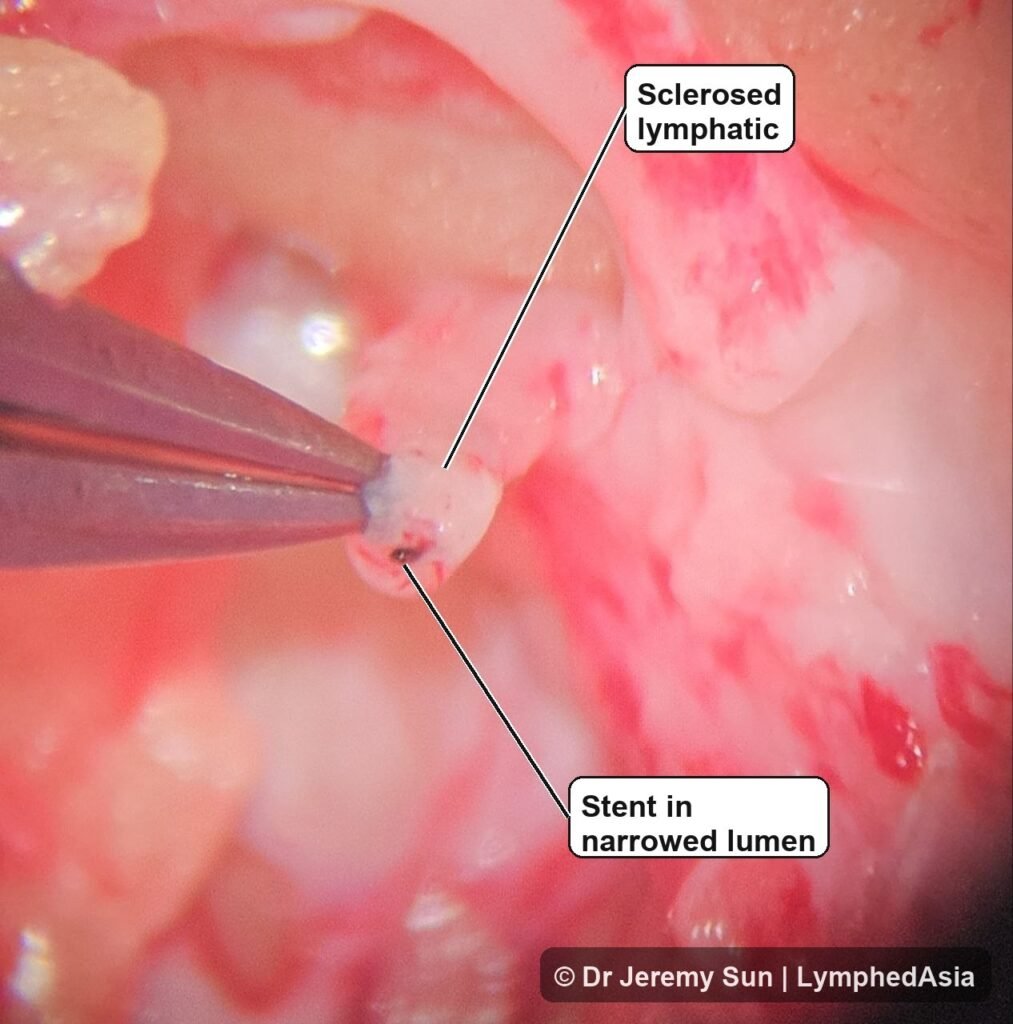
LVA depends on finding lymphatic vessels that can still carry fluid. In more advanced lymphedema, these channels may become narrowed, scarred or fully blocked. The limb may also become more fibrotic, fatty and less pitting.
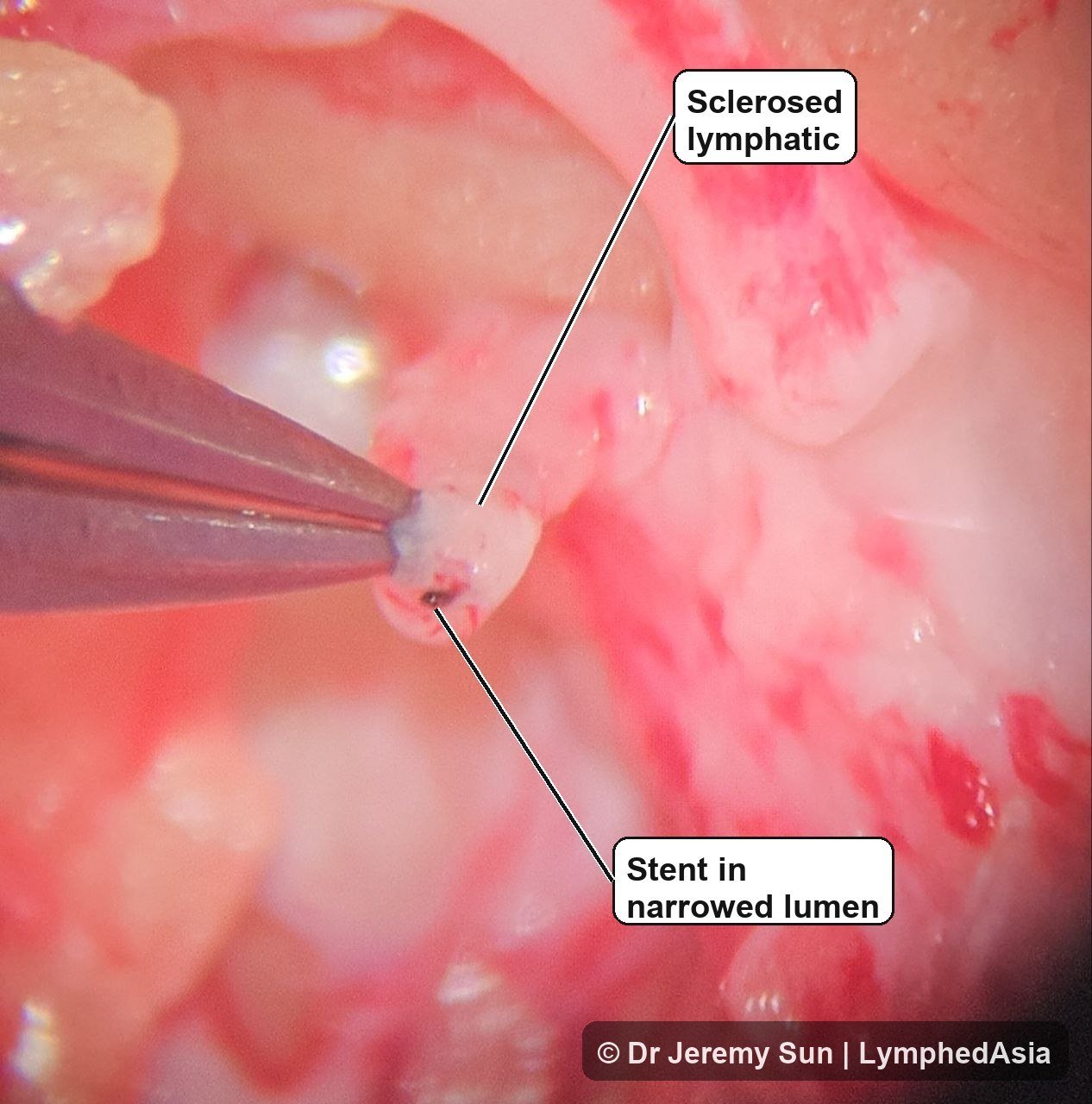
This is why timing matters. A lymphatic channel that is only narrowed today may eventually close completely if the disease continues to progress. Once a channel is completely occluded, it may no longer be useful for LVA.
The 100-lane highway explanation
A helpful way to understand lymphedema is to imagine the lymphatic system as a 100-lane highway.
The limb may not need all 100 lanes to drain comfortably. It may only need, for example, 50 lanes to remain open so that traffic can flow without major congestion.
After cancer surgery, radiation or lymph node removal, more than half of these lanes may be damaged. Once the number of functioning lanes drops below the threshold needed for smooth flow, congestion develops. That congestion is lymphedema.
LVA surgery does not rebuild the highway back to 100 lanes. Instead, it reopens or bypasses some lanes one by one. In many patients, that may be enough to bring the system back above the congestion threshold. The limb may feel lighter, swelling may improve and infections may become less frequent.
But the lymphatic system is still not normal. LVA improves function; it does not truly cure lymphedema.
Can LVA be repeated?
Yes, in selected patients, LVA can sometimes be repeated.
Lymphatic function can degrade over time. Infections, trauma, inflammation and disease progression can damage more lymphatic channels. Using the highway analogy, more lanes may close again later.
If symptoms return or worsen after an initial improvement, repeat imaging may show whether further bypasses are possible. Repeat LVA is not needed for every patient, but it can be considered when there are still usable lymphatic vessels and the patient’s symptoms justify another procedure.
So when is LVA “too late”?
There is no single time limit. It is not simply about how many years a patient has had lymphedema.
A patient who has had lymphedema for several years but still has soft, pitting swelling and good lymphatic channels on imaging may still be a candidate. On the other hand, a patient with a very firm, non-pitting, fibrotic limb may be less suitable for LVA alone.
- Whether the swelling is pitting or non-pitting
- How much fibrosis or fat deposition is present
- Frequency of cellulitis infections
- Whether lymphatic vessels are visible on ICG lymphography or ultrasound
- Previous surgery or radiation
- Patient goals and expectations
- Whether compression still helps
The decision should be based on clinical examination and lymphatic imaging, not just the stage label.
What if LVA is not enough?
If lymphedema is advanced, LVA may still have a role, but it may need to be combined with other strategies.
- Continued compression therapy
- Skin care and infection prevention
- Decongestive therapy
- Repeat LVA in selected cases
- Vascularized lymph node transfer in selected patients
- Debulking or liposuction-type procedures when there is significant solid tissue or fat deposition
The best treatment is individualized. The aim is not just to make the limb smaller, but to improve function, reduce infections, reduce heaviness and help the patient live more comfortably.
Key takeaway
LVA is usually most effective when performed earlier, before the limb becomes very fibrotic and non-pitting.
But “late” does not always mean “too late”. The real question is whether there are still functioning lymphatic channels that can be bypassed, and whether the expected benefit matches the patient’s goals.
For many patients, LVA does not cure lymphedema. But it may restore enough lymphatic function to reduce congestion, improve comfort, reduce infection risk and sometimes reduce dependence on compression. That improvement can make a major difference in daily life.
Related reading: Can LVA Cure Lymphedema?, Why Early LVA Gives Better Results, and Can I Stop Wearing Compression After LVA?.