
Clinically reviewed by Dr Jeremy Sun Mingfa, Plastic, Reconstructive and Lymphedema Surgeon in Singapore. Last reviewed: August 2026.
Short answer: early LVA often gives better results because more functional lymphatic channels are still available to bypass. In early-stage lymphedema, swelling is often more fluid-dominant and pitting, lymphatic vessels are less scarred, and the limb may still have enough reserve for LVA to produce meaningful improvement.
This does not mean LVA cannot help more advanced patients. Many advanced cases still have bypassable lymphatic vessels, especially when high-resolution ultrasound is used. But as lymphedema progresses, the operation becomes less predictable because there may be fewer usable channels and more solid tissue change.
What LVA needs in order to work well
Lymphaticovenous anastomosis, or LVA, works by connecting functioning lymphatic channels to small nearby veins. The surgery depends on finding lymphatic vessels that are still open, still carrying lymph fluid, and suitable for supermicrosurgical bypass.
When these channels are healthy enough, the bypass can redirect lymph into the venous system and improve drainage. When the channels are severely scarred, blocked or no longer carrying useful lymph flow, the yield of bypass is lower.
Why early-stage lymphedema is usually a better LVA window
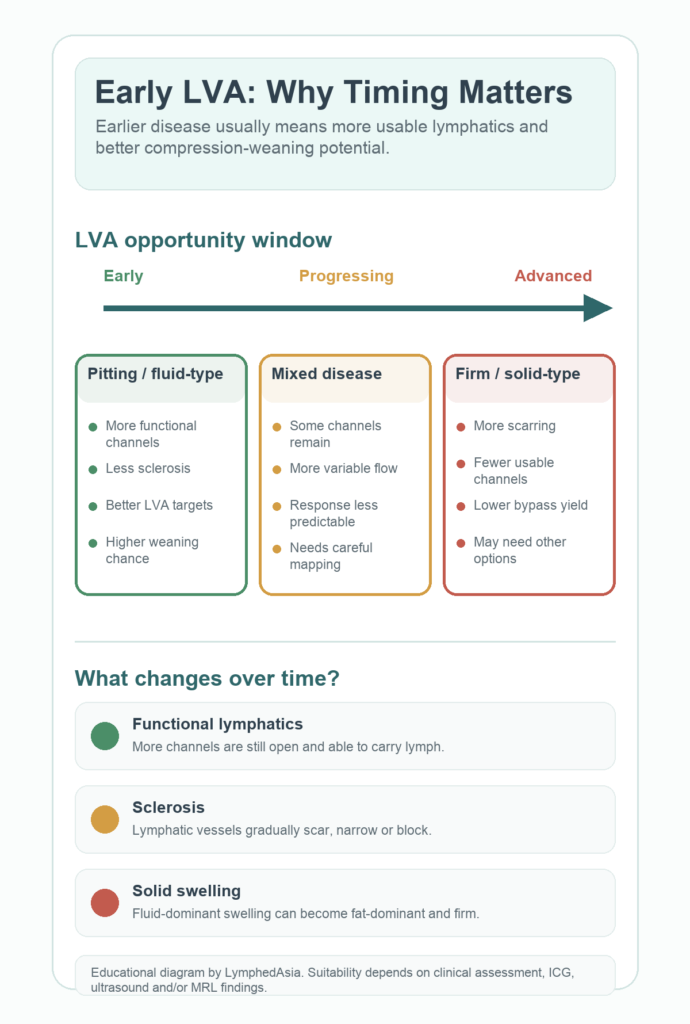
Early lymphedema often has more remaining lymphatic function. The limb may be swollen, heavy or uncomfortable, but many lymphatic channels may still be structurally usable. This gives the surgeon more potential targets and gives the patient a better chance of improvement.
- There are usually more functional lymphatic channels to bypass.
- There is often less lymphatic sclerosis, or scarring of the vessel wall.
- Swelling may be more fluid-dominant and pitting.
- The limb may have more remaining lymphatic reserve.
- The patient may have a higher chance of reducing compression dependence.
This is one reason patients should not wait until symptoms are severe before seeking specialist assessment. Earlier assessment does not always mean surgery is required, but it preserves options and helps identify when LVA might be most useful.
Pitting swelling usually suggests a more fluid-dominant problem
One practical clinical distinction is whether swelling is pitting or non-pitting. Pitting swelling means that pressure on the swollen area leaves a temporary indentation. This often suggests that fluid is still a major part of the swelling.
In Dr Jeremy Sun’s clinical view, even patients who are very swollen may still be good LVA candidates if the swelling is pitting and fluid-dominant. This is because the problem may still be partly one of impaired fluid drainage, which LVA is designed to improve.
Why firm, non-pitting swelling is less predictable
As lymphedema progresses, lymphatic vessels can undergo sclerosis. Sclerosis means scarring and hardening. Over time, lymphatic channels may narrow, become occluded, or carry less useful lymph flow. Bypassing a severely scarred channel may therefore have a lower yield.
The limb tissue can also change. Longstanding lymphedema may become more solid because of fat hypertrophy and tissue fibrosis rather than simple waterlogging. When swelling is very firm and non-pitting, LVA may still be considered if bypassable channels are found, but expectations should be more cautious.
Early LVA and compression weaning
Early-stage patients often report higher satisfaction because the goals of surgery may be more achievable. The limb may not return to a completely normal size, but improved drainage may reduce heaviness, swelling fluctuation, cellulitis risk and dependence on daily compression.
For some patients, reducing or stopping daily compression is one of the most meaningful outcomes. This is usually assessed gradually after the effect of LVA has matured. Read more: Can I stop wearing compression after LVA?
Does advanced ICG staging mean LVA is impossible?
Not always. ICG lymphography is useful, but it mainly shows superficial lymphatic flow and has limited tissue penetration. In higher-BMI patients or severe lymphedema, deeper functional vessels may not appear clearly. Dermal backflow can also obscure deeper linear channels.
This is why ultrasound mapping for LVA can be important. High-resolution ultrasound may identify deeper bypassable lymphatic vessels even when ICG appears advanced or does not show clear linear channels.
Should everyone have early LVA?
No. Early assessment is not the same as automatic surgery. Some patients are best treated first with compression, skin care, exercise, weight optimisation and specialised lymphedema therapy. Many patients should complete a period of conservative treatment before surgery is considered.
The important point is timing. If conservative treatment is not controlling symptoms adequately, or if lymphedema is progressing, earlier specialist assessment may identify a window where LVA has better targets and better potential benefit.
How this fits into specialist assessment
A good LVA assessment looks beyond limb size alone. It considers the history of cancer treatment, cellulitis episodes, pitting versus non-pitting swelling, tissue firmness, compression response and imaging findings. ICG lymphography, ultrasound and magnetic resonance lymphangiography may each provide different information.
Related guides: LVA surgery in Singapore, can LVA cure lymphedema?, lymphedema surgery options, and choosing a lymphedema surgeon in Singapore.
Key takeaways
- Early-stage lymphedema usually has more functional lymphatic channels for LVA.
- Pitting, fluid-dominant swelling often gives a better LVA opportunity window.
- Firm, non-pitting, solid swelling is usually less predictable because of sclerosis, fibrosis and fat-dominant change.
- Advanced ICG findings do not always mean LVA is impossible, especially when ultrasound can identify deeper targets.
- Earlier assessment may preserve options and improve the chance of compression reduction in suitable patients.
Frequently asked questions
Why does early LVA work better?
Early LVA often works better because more lymphatic channels are still open and functional. There is usually less scarring and more fluid-dominant swelling, giving the surgeon better bypass targets.
Can LVA still work in advanced lymphedema?
Sometimes. Advanced lymphedema may still have bypassable channels, particularly when ultrasound is used to identify deeper vessels. However, the response is usually less predictable than in early disease.
Is pitting swelling a good sign for LVA?
Pitting swelling often suggests a fluid-dominant component, which may respond better to lymphatic drainage improvement. Suitability still depends on specialist assessment and imaging.
Should I wait until lymphedema becomes severe before considering LVA?
Usually no. Waiting until swelling becomes firm, solid and non-pitting may reduce the number of usable lymphatic channels. Earlier assessment helps preserve options, even if surgery is not immediately required.
Related guide: When Is LVA Surgery Too Late for Lymphedema? explains how pitting, fibrosis and narrowed lymphatic channels affect whether LVA remains suitable in later-stage lymphedema.