
Clinically reviewed by Dr Jeremy Sun Mingfa, Plastic, Reconstructive and Lymphedema Surgeon in Singapore. Last reviewed: August 2026.
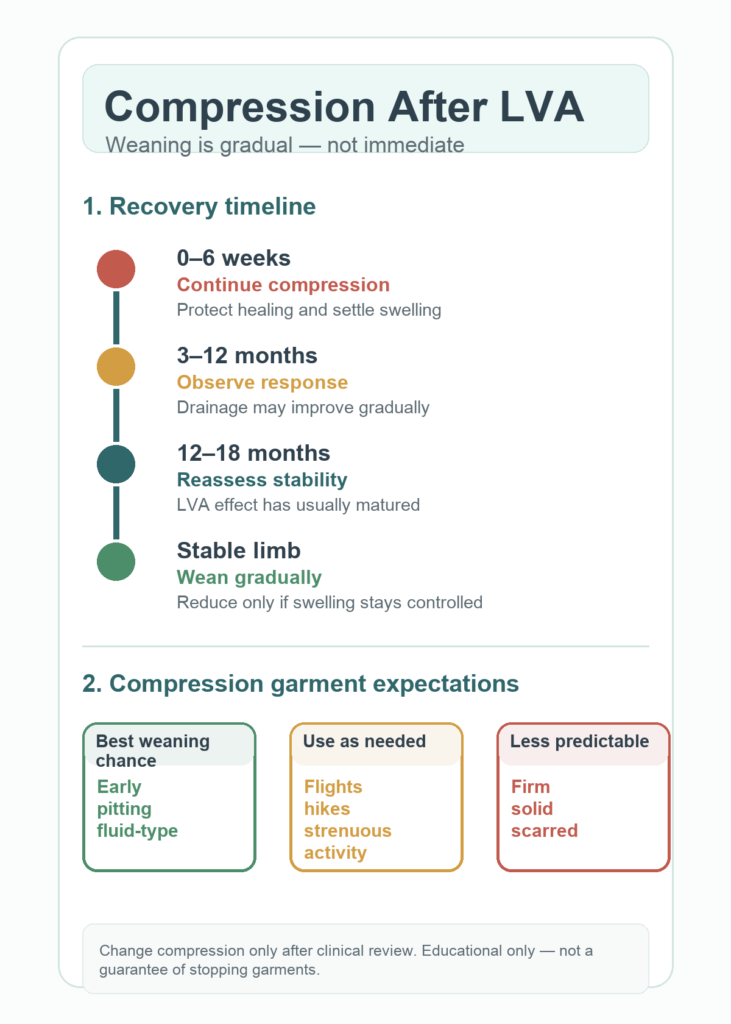
Short answer: some patients can reduce or even stop daily compression after LVA, but it is not immediate and it is not guaranteed. In most cases, compression is reassessed gradually around 12 to 18 months after lymphaticovenous anastomosis (LVA), when the benefit of the bypasses has had enough time to mature.
For selected patients, especially those with early-stage, fluid-dominant lymphedema, LVA may improve lymphatic drainage enough that daily compression can be reduced. A smaller group may stop regular compression altogether, using it only during higher-risk situations such as long flights, long hikes, prolonged standing, heat exposure or episodes where swelling tends to flare.
Why compression is not usually stopped immediately after LVA
LVA creates tiny bypasses between suitable lymphatic channels and nearby veins. These bypasses are designed to give lymph fluid an alternative route to drain. However, the limb still needs time to settle after surgery, and the lymphatic system does not become normal overnight.
Compression remains important in the early period because it helps control swelling while the limb adapts. Stopping too quickly may make it harder to judge whether the improvement is durable or simply a short-term fluctuation.
Why reassessment is often around 12 to 18 months
In Dr Jeremy Sun’s practice, compression is typically reassessed approximately one year to 18 months after LVA. By this time, the clinical effect of the LVA has usually had a fair chance to play out.
This does not mean every patient must wait exactly the same length of time. The timing depends on the limb, the severity of lymphedema, the quality of the bypasses, the patient’s symptoms, infection history and objective measurements. But as a general principle, compression weaning should be based on stable improvement rather than hope alone.
How compression weaning is usually approached
If the limb is stable, compression is usually reduced gradually rather than stopped abruptly. The aim is to see whether the improved lymphatic drainage can maintain control during normal daily life.
- Compression hours may be reduced step by step.
- The patient monitors swelling, heaviness, tightness, skin changes and comfort.
- Limb measurements or clinical review may be used to check stability.
- Compression is resumed or increased if symptoms return.
Some patients eventually use compression only during predictable stressors, such as travel, prolonged standing, exercise events, long hikes or hot weather. Others still need regular compression, but may be able to use it for fewer hours or with less dependence than before surgery.
Who is more likely to reduce or stop compression?
The patients most likely to reduce compression are usually those with earlier lymphedema and better remaining lymphatic function. Early-stage disease tends to have more functional lymphatic channels and less scarring, which gives LVA better targets to bypass.
- Early-stage lymphedema generally has better LVA outcomes.
- Pitting, fluid-dominant swelling often suggests that fluid drainage is still a major part of the problem.
- More usable lymphatic channels mean more opportunities for effective bypass.
- Good postoperative stability increases the chance of safe compression reduction.
This is one reason early assessment matters. Waiting until the limb becomes very firm and non-pitting may reduce the number of useful lymphatic channels available for bypass.
Why advanced or solid lymphedema is different
In more advanced lymphedema, lymphatic vessels may undergo sclerosis, which means scarring and progressive narrowing or blockage. When a lymphatic channel is badly scarred or occluded, bypassing it may have a lower yield because there is less useful lymph flow to redirect.
Very firm, non-pitting swelling often suggests a more solid, fat-dominant component rather than purely fluid-dominant swelling. LVA may still be considered if imaging or ultrasound identifies bypassable channels, but compression freedom is less predictable in this group.
Is stopping compression the same as being cured?
No. LVA does not cure lymphedema by restoring a completely normal lymphatic system. It improves drainage capacity. If the improvement is enough to keep the limb stable during daily life, the patient may feel functionally much better, and in selected cases may no longer need daily compression.
For patients, this distinction is important. Medically, the lymphatic reserve remains reduced. Practically, however, not needing to wear compression every day can feel close to being cured because it changes daily life, clothing choices, work, travel and exercise.
When compression may still be needed after LVA
Even after a good response, compression may still be useful during situations that increase lymphatic load or reduce lymphatic reserve. Examples include long flights, long hikes, prolonged standing, hot environments, weight gain, trauma or episodes of cellulitis.
Lymphatic function can also deteriorate with time. Ageing, infection, trauma, inflammation and increased body fat composition may reduce the remaining reserve. This is one reason some patients may later need renewed compression, closer monitoring or even repeat LVA in selected circumstances.
How this fits into LVA decision-making
Compression reduction should not be the only reason to consider LVA. The goals may include better swelling control, reduced heaviness, fewer flare-ups, lower cellulitis risk and easier long-term management. Patients considering surgery should have a detailed assessment of disease stage, swelling quality, imaging findings and realistic goals.
Related guides: LVA surgery in Singapore, why early LVA gives better results, lymphedema surgery options, ultrasound mapping for LVA, and choosing a lymphedema surgeon in Singapore.
Key takeaways
- Some patients can reduce compression after LVA, but this is not guaranteed.
- Compression is usually reassessed gradually around 12 to 18 months after surgery.
- Early-stage, pitting, fluid-dominant lymphedema has a better chance of compression reduction.
- Advanced solid lymphedema and lymphatic sclerosis make compression freedom less predictable.
- Stopping daily compression is not the same as curing lymphedema, but for selected patients it can be a major functional improvement.
Frequently asked questions
Can I stop compression immediately after LVA?
Usually no. Compression is generally continued early after surgery and reduced only after stability is demonstrated. Stopping too early can make swelling harder to control.
When is compression usually reassessed?
Many patients are reassessed around 12 to 18 months after LVA, when the effect of surgery has had time to mature. The exact timing depends on individual progress.
Who has the best chance of reducing compression?
Patients with earlier-stage, pitting, fluid-dominant lymphedema and good bypassable lymphatic channels generally have a better chance of reducing compression.
If I stop compression, does that mean my lymphedema is cured?
No. It means the limb may be stable enough for daily life without regular compression. The underlying lymphatic reserve is still reduced, so compression may still be needed during higher-risk situations.
Related guide: When Is LVA Surgery Too Late for Lymphedema? explains how pitting, fibrosis and narrowed lymphatic channels affect whether LVA remains suitable in later-stage lymphedema.