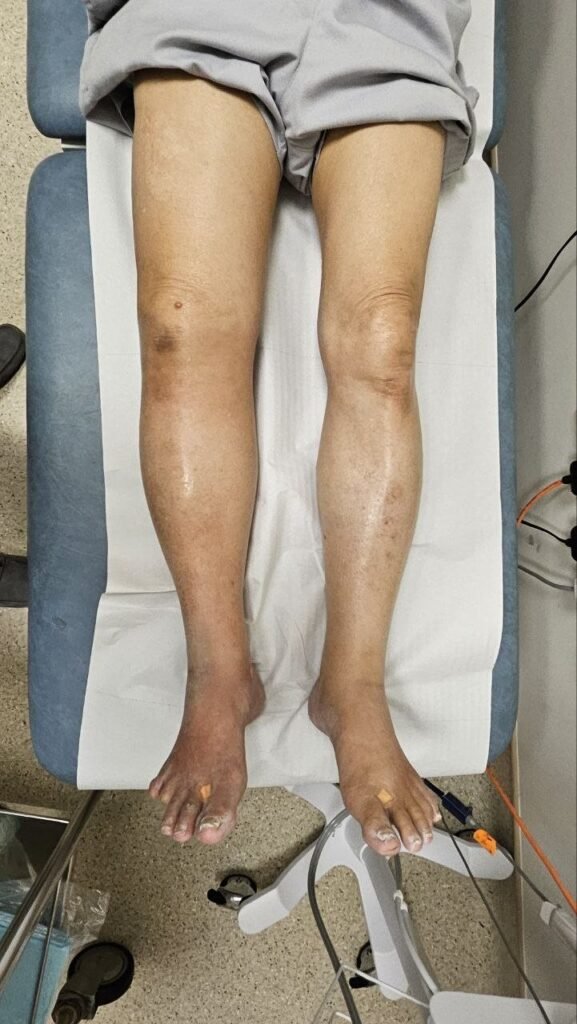
Nobody warned you it would be like this. The appointment where you received your diagnosis focused on compression garments and skin care. It did not mention that you might stop swimming. That you might start turning down dinner invitations. That you might lie awake at 2am worrying about what a long-haul flight will do to your arm. And it almost certainly did not tell you that what you are experiencing is documented, measurable, and far more common than you have been led to believe.
Clinically reviewed by Dr Jeremy Sun Mingfa, Senior Consultant Plastic and Reconstructive Surgeon in Singapore, with subspecialty expertise in lymphedema surgery and supermicrosurgical lymphatic reconstruction. Last reviewed: August 2026.
Research on lymphedema quality of life has expanded significantly over the past two decades. Multiple large studies, systematic reviews, and validated patient-reported outcome tools now describe, in precise detail, how this condition affects not just the body but virtually every dimension of daily life – physical, emotional, social, occupational, and relational.
This article walks through what the research actually shows, domain by domain. It explains how quality of life is measured in lymphedema, what the evidence says about specific impacts, and what effective treatment can realistically change. By the end, you will have a clearer picture of where your experience fits within the evidence – and what you can reasonably ask for from your care team.
Why Does Lymphedema Affect So Many Areas of Life at Once?
Most chronic conditions affect one or two domains of daily life significantly. Lymphedema is different. Its impact tends to be multi-directional, and the reasons for this become clear when you look at what the condition actually demands.
First, lymphedema is not a stable condition that you adjust to and then maintain. It requires active, indefinite daily management. That means compression garments every morning, careful skin monitoring, avoidance of heat, awareness of infection risk, and modifications to exercise, diet, and activity. The vigilance itself becomes a burden – one that operates in the background of every decision you make.
Second, the condition is unpredictable in ways that most chronic conditions are not. Lymphedema can be stable for weeks or months, then worsen significantly after a minor skin infection, a long journey, or a period of heat. That unpredictability makes it hard to commit to work schedules, social plans, or anything that requires consistency – and that pattern of withdrawal, repeated over time, accumulates into significant losses.
Third, lymphedema often coexists with another major health experience – most commonly cancer treatment. For patients with cancer-related lymphedema, the swelling is a physical reminder of a cancer diagnosis they are trying to move beyond. This layering of experiences makes the psychological burden particularly complex.
According to a systematic review published in the Journal of Cancer Survivorship, patients with secondary lymphedema (lymphedema caused by cancer treatment) report substantially lower health-related quality of life scores than cancer survivors without lymphedema, even when their cancer itself is in remission. In clinical practice, this means the lymphedema – not the cancer – becomes the dominant day-to-day burden for many survivors.
How Do Clinicians Actually Measure Quality of Life in Lymphedema?
For many years, lymphedema treatment outcomes were measured almost exclusively in physical terms – limb circumference, volume, and fluid content. Quality of life was acknowledged as important but rarely tracked with the same rigour.
That has changed. Researchers have developed several validated tools specifically designed to measure how lymphedema affects daily life. The two most widely used are:
- LYMQOL (Lymphoedema Quality of Life Tool) – a patient-completed questionnaire with four subscales: function, appearance, symptoms, and mood. It produces both subscale scores and an overall quality of life rating, allowing clinicians to track changes over time.
- LYMPH-ICF (Lymphedema Functioning, Disability and Health Questionnaire) – a broader tool based on the World Health Organization’s International Classification of Functioning framework, covering physical function, mental function, daily activities, and social participation.
- FACT-B+4 (Functional Assessment of Cancer Therapy – Breast plus lymphedema subscale) – commonly used in cancer-related lymphedema research, particularly for breast cancer survivors.
These tools matter because they make quality of life a measurable clinical outcome – not just a conversation topic. When your clinic uses one of these tools at each appointment, it becomes possible to see whether your quality of life is improving, stable, or worsening in response to treatment – independent of what is happening to your limb circumference.
In clinical practice, this means asking your clinic whether they use a validated QoL tool is a reasonable and worthwhile question. If they do not, asking whether they can is not unusual. Tracking how you are functioning across these domains creates an evidence base for adjusting treatment when physical measurement alone is not telling the whole story.
What Does the Research Show Across the Key Domains of Daily Life?
Across multiple studies using validated tools, six domains consistently emerge as significantly affected by lymphedema. The table below maps what research finds in each domain against what patients actually report in their own words.
| QoL Domain | What Research Finds | What Patients Commonly Report |
| Physical function | Reduced limb mobility, slower gait, difficulty with strength and fine motor tasks | Cannot carry shopping, trouble with stairs, avoids exercise previously enjoyed |
| Psychological wellbeing | Elevated anxiety and depression rates vs. general population; fear of recurrence in cancer survivors | Constant worry about flare-ups; feels defined by the condition |
| Social participation | Withdrawal from activities, reduced travel, changes to intimacy and relationships | Declines social invitations, avoids beaches or gyms, feels isolated |
| Occupational function | Significant absenteeism and role reduction, especially in physical or standing jobs | Reduced hours, career changes, early retirement due to symptoms |
| Sleep quality | Limb heaviness and discomfort disrupt sleep; fatigue compounds daytime function | Wakes due to tightness, difficulty finding a comfortable position |
| Body image | Distress around visible swelling, clothing limitations, perceived loss of body control | Avoids mirrors, difficulty finding clothes that fit, reduced confidence |
The breadth of this table matters. Living with lymphedema daily is not one problem – it is a cluster of connected losses, each amplifying the next. Physical limitations reduce social participation. Social withdrawal increases psychological distress. Psychological distress reduces motivation to adhere to self-management. And reduced self-management allows the condition to progress further.
This cycle – physical burden leading to psychological distress leading to reduced self-care leading to worsening physical burden – is one of the most important patterns in lymphedema QoL research, and one of the strongest arguments for treating the emotional and social dimensions of the condition with the same seriousness as the physical ones.
How Significant Is the Emotional Burden of Lymphedema – and Why Is It Often Missed?
Of all the quality of life domains affected by lymphedema, the psychological one is the most consistently underreported by patients and underassessed by clinicians. Understanding why helps explain what to look for in your own experience.
Studies consistently find elevated rates of anxiety and depression among people with lymphedema. According to research published in Supportive Care in Cancer, approximately 30 to 50 percent of patients with cancer-related lymphedema report clinically significant levels of psychological distress – including anxiety about disease recurrence, distress around visible body changes, and frustration with the demands of ongoing self-management.
Several specific psychological patterns emerge repeatedly in the literature. Fear of recurrence – the worry that swelling might indicate cancer returning – keeps many survivors in a state of low-level hypervigilance. Even stable lymphedema, well-managed, can trigger this anxiety with each new change in the limb.
Body image distress is another major and underaddressed factor. Research using LYMQOL subscales consistently shows that distress around visible swelling, difficulty with clothing, and the perceived loss of control over one’s own body correlates strongly with reduced overall quality of life scores – in some studies, more strongly than pain or physical limitation alone. This distress is particularly pronounced during summer months, at formal events, and in professional settings where patients feel that the compression garment marks them as unwell.
The lymphedema emotional burden also extends beyond the individual. Partners and caregivers frequently absorb additional responsibilities around garment care, wound monitoring, and physical support. A growing body of research has begun to document the secondary psychological burden on caregivers – one that rarely surfaces in a clinical appointment but significantly affects the household.
| DR. SUN’S CLINICAL PERSPECTIVE“In my practice, I see a consistent pattern: patients arrive having managed their swelling alone for months or years, often because they were told there was nothing more to be done. By that point, the psychological toll is frequently as significant as the physical one – sometimes more so. They have stopped going to social events. They have changed careers. Some have withdrawn from relationships entirely. This means for patients that the emotional burden of lymphedema is not a side effect – it is a core part of the condition, and it deserves exactly the same clinical attention as limb volume or skin health. When we treat lymphedema effectively – whether through compression, microsurgery, or a combination of both – we routinely see improvements in mood, confidence, and daily function that patients genuinely did not expect. Quality of life is a measurable outcome, not a vague feeling. It should be tracked, treated, and reported at every appointment.”– Dr Jeremy Sun, Lymphedema Microsurgery Specialist, Singapore |
What Does the Evidence Say About the Impact on Work and Social Life?
The occupational impact of lymphedema is one of the most striking and least-discussed findings in the QoL literature.
A study published in the Annals of Surgical Oncology found that women with breast cancer-related lymphedema were significantly more likely to report work absenteeism, reduced hours, and early exit from employment compared to breast cancer survivors without lymphedema. The effect was particularly pronounced in jobs requiring repetitive arm movements, physical lifting, prolonged standing, or working in heat – but it was not limited to manual roles.
Office workers and professionals report their own occupational costs: difficulty typing for extended periods, carrying files or equipment, or managing a full working day without symptoms. Professionals in client-facing or public roles describe ongoing anxiety about the visible appearance of their affected limb and the fatigue of explaining the condition repeatedly.
Some patients describe what researchers call ‘career foreclosure’ – the decision to step back from promotion, decline new responsibilities, or accept early retirement not because the role was impossible, but because the management burden of the condition made full engagement unsustainable. This is a significant and largely invisible economic impact of lymphedema that is rarely captured in standard clinical assessments.
Social participation declines in ways that are both subtle and significant. Research documents reduced engagement in leisure activities, withdrawal from exercise groups or sports, changes to intimacy and sexual wellbeing, and reluctance to travel – particularly by air, due to the well-founded concern that pressurised aircraft cabins can worsen swelling.
The QoL lymphedema research also documents something patients know well but clinicians rarely raise: the social cost of compression garments in warm or formal settings. Wearing a sleeve or stocking to a wedding, on a beach holiday, or during an important professional presentation is not a neutral act. It requires preparation, explanation, and a kind of ongoing visibility that many patients find quietly exhausting over time.
How Does Lymphedema Affect Sleep and Energy Levels?
Fatigue in lymphedema is not simply tiredness. It is a specific and documented symptom that the research distinguishes from the general fatigue of cancer treatment or chronic illness.
The physical mechanisms are several. Limb heaviness and tightness make comfortable sleeping positions difficult to find. Some patients report waking repeatedly due to discomfort or the sensation of pulsing in the affected limb. Others find that the time required for morning bandaging or garment care significantly reduces usable time in the early part of the day.
According to research using the LYMPH-ICF, disrupted sleep is among the most consistently reported functional limitations in patients with moderate to advanced lymphedema – more consistently reported than pain, and nearly as consistently as limb heaviness itself.
The relationship between sleep and psychological wellbeing in lymphedema is bidirectional. Poor sleep worsens mood and increases anxiety. Increased anxiety – particularly the overnight worry about the condition – further disrupts sleep. This cycle is clinically important because it means that improving sleep quality may have downstream effects on psychological wellbeing, self-management adherence, and physical outcomes.
Fatigue also compounds the occupational impact described above. A patient managing significant sleep disruption alongside the daily demands of lymphedema self-care starts each working day already at a deficit – one that accumulates across weeks and months in ways that standard clinical measurements do not capture.
Can Treatment Improve Quality of Life – Not Just the Swelling?
This is the most important practical question for anyone living with lymphedema, and the evidence here is genuinely encouraging.
Studies examining outcomes from complete decongestive therapy (CDT) – the established combination of manual lymphatic drainage, compression, therapeutic exercise, and skin care – show improvements not just in limb volume but in patient-reported quality of life scores across physical, psychological, and social subscales. The improvements are often most pronounced in mood and social function, reflecting how much psychological distress responds to effective physical treatment.
Surgical interventions, where appropriate, show even more significant and durable quality of life gains. Research on lymphovenous anastomosis (LVA) and vascularised lymph node transfer (VLNT) documents sustained improvements in limb heaviness, infection frequency, garment dependence, and – consistently – psychological wellbeing. Patients report feeling less defined by their condition, more willing to engage socially, and more confident in planning activities and travel.
According to a systematic review published in the European Journal of Surgical Oncology, patients who underwent surgical treatment for lymphedema reported statistically significant improvements in LYMQOL scores at 12 months post-procedure – with the largest gains appearing in the psychological and social subscales, not just the physical ones. The implication is that reducing the physical burden of lymphedema has a multiplying effect on the other domains.
Compression innovation has also contributed to quality of life improvements in ways that extend beyond symptom control. Flat-knit custom garments, adjustable wrap systems, and newer low-profile sleeve designs have reduced some of the social and aesthetic burdens of garment wear. While these are not curative, they lower the daily friction of living with the condition.
In clinical practice, this means that raising quality of life outcomes explicitly with your specialist is a legitimate clinical request – not an optional extra. Treatment goals should include your ability to work, sleep, engage socially, and move through your life without the condition dominating every decision you make.
How Do You Raise Quality of Life Concerns With Your Care Team?
Many patients find it easier to report physical symptoms than emotional or social ones. There is a tendency to minimise – to assume that the psychological and social impacts are not relevant to a clinical appointment, or that nothing can be done about them. Neither is true.
If your daily function, mood, relationships, or career are being affected by lymphedema, your specialist needs to know. Here are practical ways to make that conversation productive:
- Be specific about the impact. Instead of “I feel down,” say “I have stopped socialising because the compression garment in heat is too difficult to manage.” Specificity gives your clinician something to respond to.
- Ask about validated QoL tools. Ask whether the clinic uses LYMQOL or a similar instrument. If they do not, ask whether they can. Having your quality of life measured over time creates a record that supports changes to your treatment plan.
- Ask explicitly about surgical options if conservative management is not producing the quality of life you want. Not every patient is a surgical candidate, but many who could benefit are never referred for assessment – often because they did not ask.
- Name the occupational impact. If lymphedema is affecting your working hours, your career choices, or your income, say so explicitly. This is clinically and practically relevant, and it may support access to additional services or treatment prioritisation.
- Involve your caregiver if appropriate. If a partner or family member is significantly affected by the demands of your condition, they may benefit from being included in the clinical conversation. The burden on caregivers is real, increasingly recognised, and addressable.
If your concerns about lymphedema quality of life have not been adequately heard or addressed, speaking with a specialist who treats the whole condition – not just the limb measurement – can make a measurable difference. Dr Jeremy Sun consults at Lymphedema Asia, a specialist lymphedema clinic in Singapore, where both conservative management and surgical assessment are available in a single clinical setting.